A First-Time Designer Made a Couture Collection With No Training. Here Is How.
By Egoyibo Okoro · June 2026
There is a belief that good design requires years of training. Pattern cutting. Draping. A fashion-school portfolio and an apprenticeship in an atelier. The craft is real and the training is real. But the belief hides a second, quieter assumption: that without that training, your ideas have nowhere to go.
We want to challenge that assumption with a single documented example.
A first-time designer. A couture collection. Day one.
Kosy Okoro is Akwa's Growth Manager, and as of this week our newly appointed Creative Director. He is not a trained fashion designer. The collection described here was made up of his first attempts at designing anything at all, produced within hours of getting access to the tools.
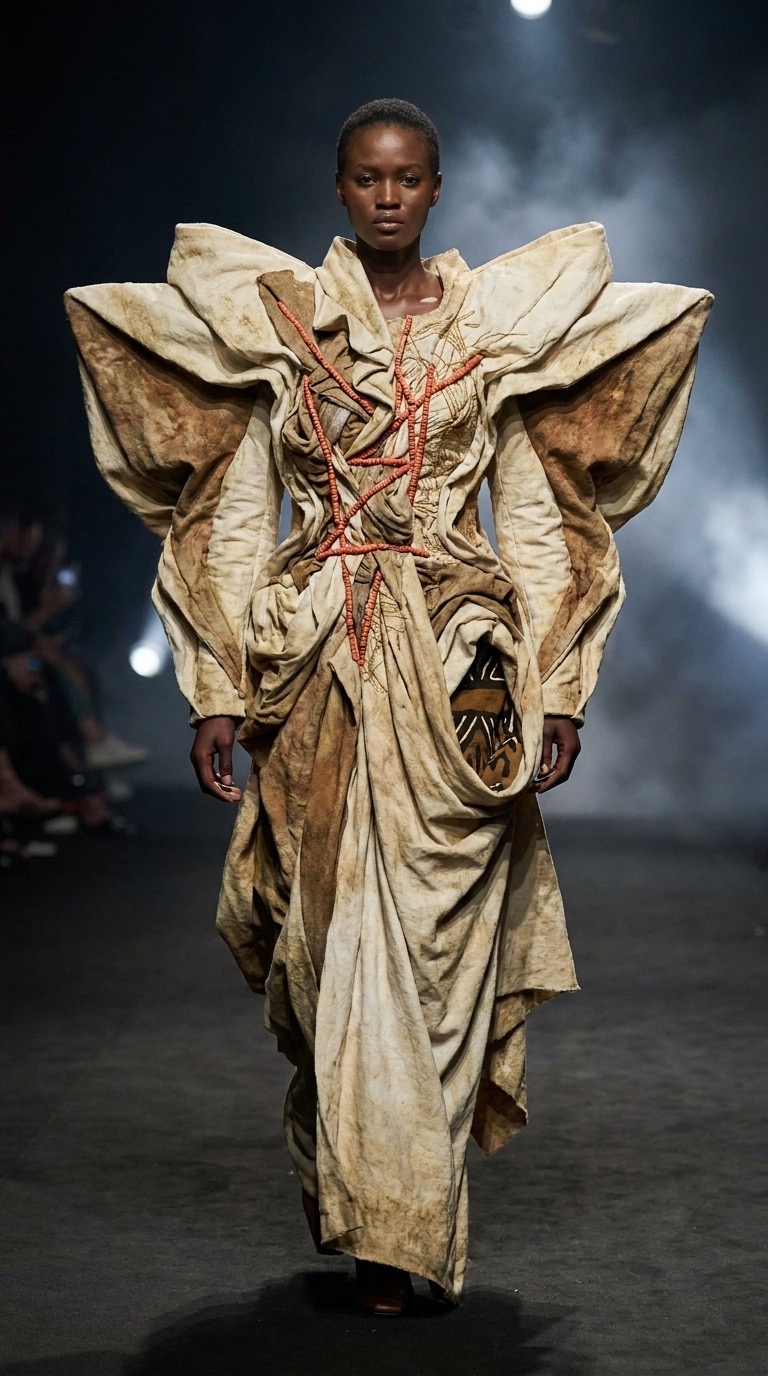
What came back was not one lucky image. It was a cohesive body of work: a run of looks that held together with a single recognisable hand, moving from sculptural tailoring to undyed minimalism to heritage-fused drama, every one of them reading as a couture-level concept on the platform, not a manufactured garment.
If a trained creative director had made them, it would be a nice portfolio. Because someone with taste and ideas but no formal training made them on the first sitting, it is something else. It is evidence that the distance between having an idea and producing professional-grade design has collapsed.
The gap Akwa closes
Most people with a sense of style have had the same experience. You can see the garment clearly in your head. You can describe it. You might even sketch it. And then nothing happens. You cannot cut the pattern. You do not know how the shape is held up. You have no atelier, no sample machinist, no way to hand a maker something they can actually make.
That gap, between having taste and producing executable design, is the thing Akwa exists to close. Not the picture. The buildable design underneath it.
Does it actually understand couture? We checked.
It is easy to make a beautiful image. The harder claim is that a platform understands construction, and the hardest test of that is couture and avant-garde, where an exaggerated silhouette is held up by hidden engineering a standard tailor would never intuit.
Take one piece from the collection: an avant-garde gown with sculptural sleeves and coral-bead architecture down the bodice. Akwa did not stop at rendering it. It reverse-engineered how an atelier would physically achieve the shape. A boned corselette foundation carries the bodice independent of the outer shell. Hair canvas and horsehair support stand the structure away from the body. The sleeve heads are built over internal shapers. The weight is balanced so the garment sits on the body without dragging or tipping, and the build order constructs the foundation first and mounts the shell over it. That is not a description of the garment. That is a specification a specialist could build from.
The same is true across the collection. Every piece carries a construction brief a tailor can work from, not a mood board.
Origin-native, and unboxable
Akwa began with a conviction that cultural origin should be the structural foundation of a design, not a decorative overlay. That conviction stands. But originality is not owned by any single heritage, and Akwa is not a heritage-only tool.
The collection makes the point on its own. It is multi-cultural and multi-purpose. Western avant-garde and deconstructed tailoring sit beside undyed minimalism and heritage-fused drama, and each one is original in its own language. A folded-sleeve cream gown is as native to its lineage as a coral-beaded robe is to its. We do not believe originality should be seen only through an African, Asian, or non-Western lens. In 2026, anyone can be whatever and whoever they want to be, and so can the work they make.
What stays constant across all of it is not a fabric or a continent. It is the bridge from idea to buildable design.
Where Akwa is different
General AI image tools are widely used for fast visual exploration and brand-creative work. They are good at turning a prompt into a striking picture. If what you need is an image, they will give you one.
Akwa is built for the step after the image. It encodes the construction grammar of a garment, the understructure that holds a silhouette, the fabric behaviour, and the construction order, and it produces a tailor-ready brief alongside the render. Akwa wins for the thing the others were not built to do: turning an untrained person's idea into a design that can actually be made, across any cultural register.
That is the difference between a picture of a garment and a garment you can hand to a maker.
What the experiment actually proved
It is worth being precise about what this shows, because the easy version overclaims. The point was not simply that a novice generated attractive couture concepts. Attractive concepts are cheap. The real test was whether a design intent could survive the whole chain: from an idea, into structured design decisions, into a visual output, into a technical interpretation a maker could read, and through review, without quietly becoming a different garment along the way.
That is the part worth trusting: the intent held its shape across those stages. It is a demonstration of the design and specification chain, from imagination to a maker-ready brief, rather than a manufacturing run. Where the platform's assumptions get tested against real cloth is Drop 01, Akwa's own production collection. Keeping those two claims separate, what has been demonstrated on the platform versus what has been validated in physical manufacture, is exactly the honesty the tool is built to preserve.
Built by one person, in the margins
Akwa was built in the margins of a demanding career, by one person, not a fashion-tech team, because the gap between imagination and made things felt worth closing. A first-time collection that reads like couture is, in a sense, the clearest answer to whether it worked.
You do not need a fashion degree to design something worth making. You need an idea, taste, and an instrument that takes both seriously.
Design something only you would make.
Editor’s note, September 2026: Kosy Okoro is now a co-founder and designer of Yibo & Kosy, the fashion house founded with Egoyibo “Yibo” Okoro and powered by Akwa. Read the siblings’ story.