Used in production: the tech packs behind our own collection
The first Yibo & Kosy collection, conceived under the house’s former name, Egoyibo Okoro, was not a render reel. We generated the tech packs on Akwa and handed them to a renowned Turkish manufacturer, who sampled the collection from them. The documentation you receive is the documentation we trusted to cut our own first samples, so you can send yours to a factory with the same confidence when you commission your first sample.
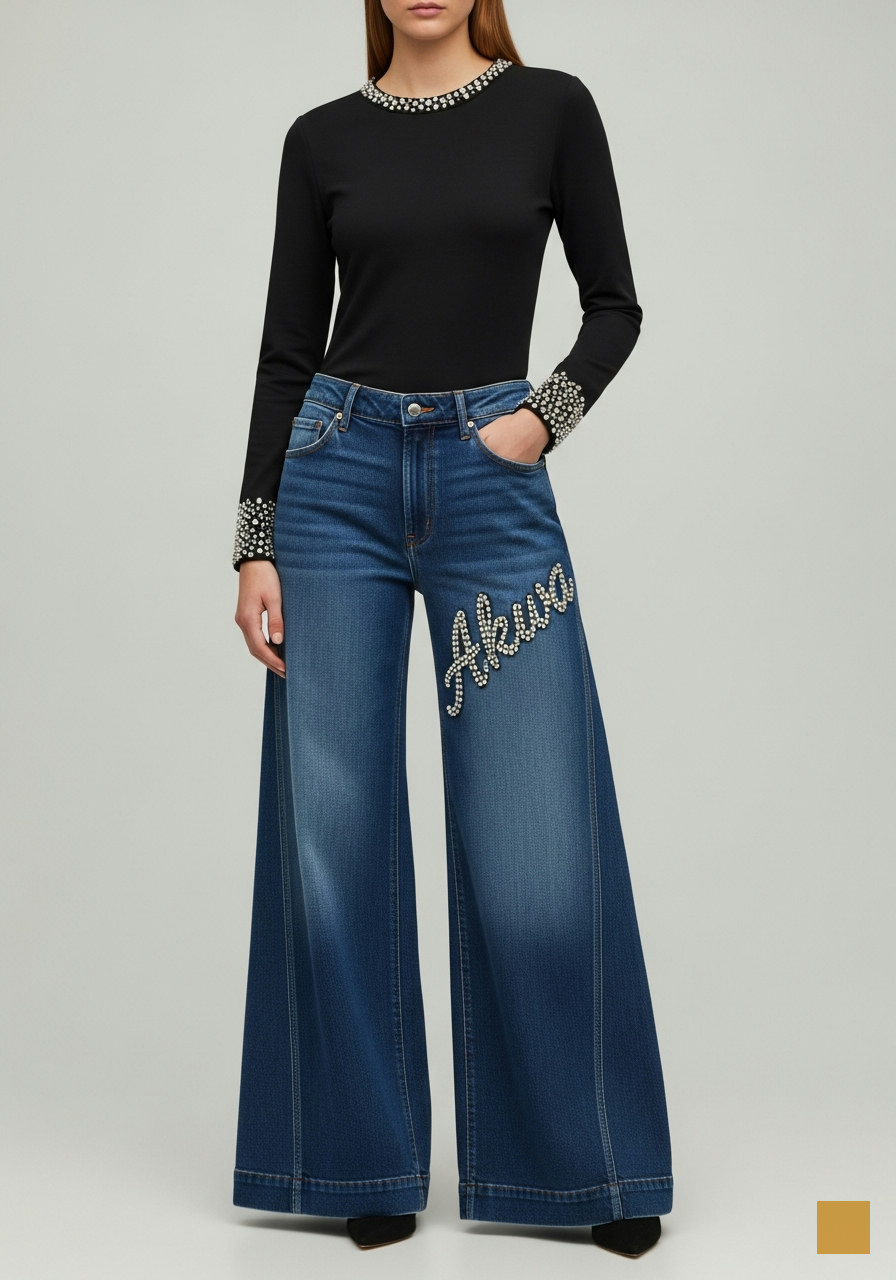
See the pack, page by page
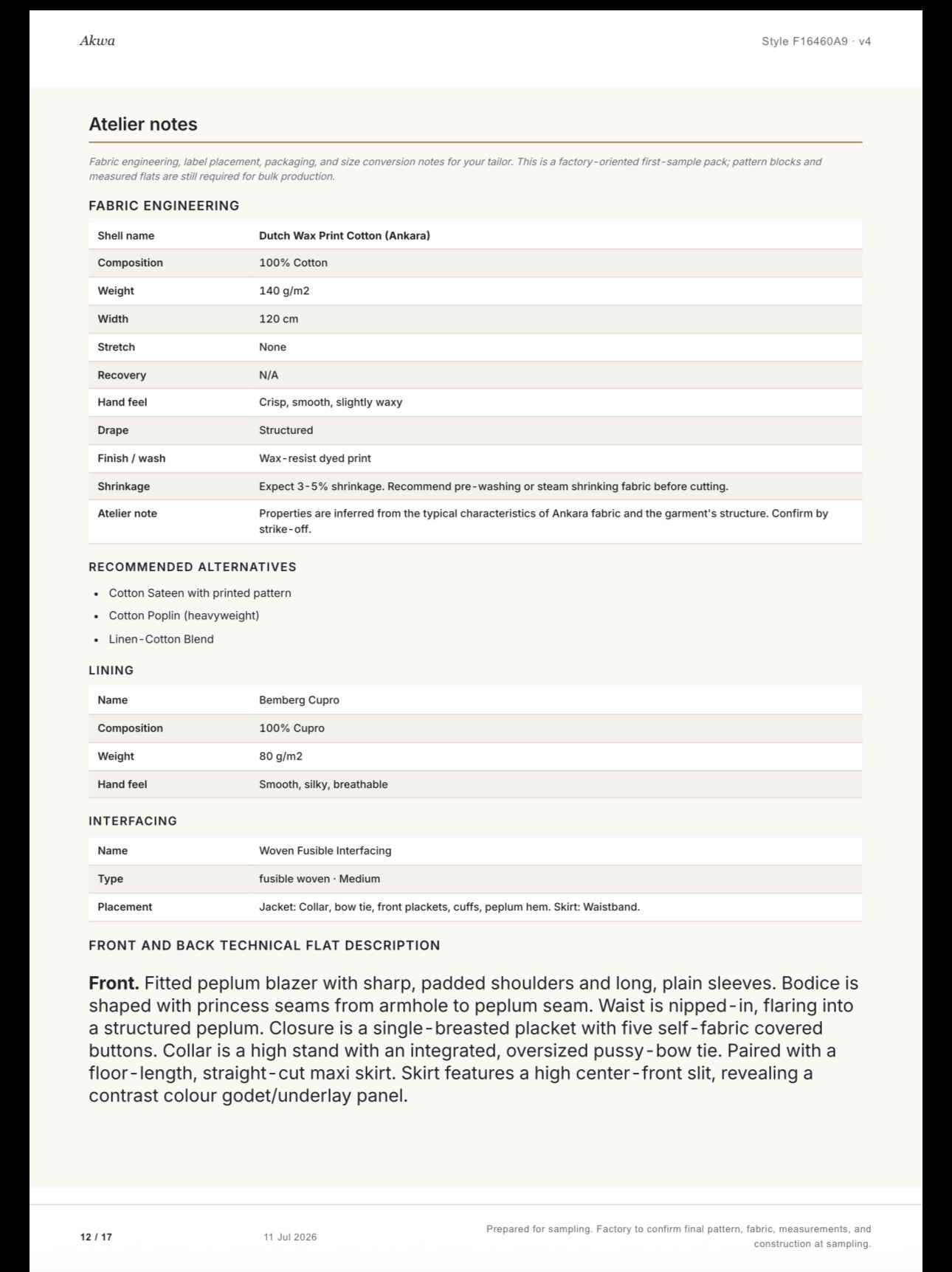
A real Akwa Tech Pack for a wide-leg denim co-ord, from the uploaded design through to atelier notes. One image in; a complete factory specification out.
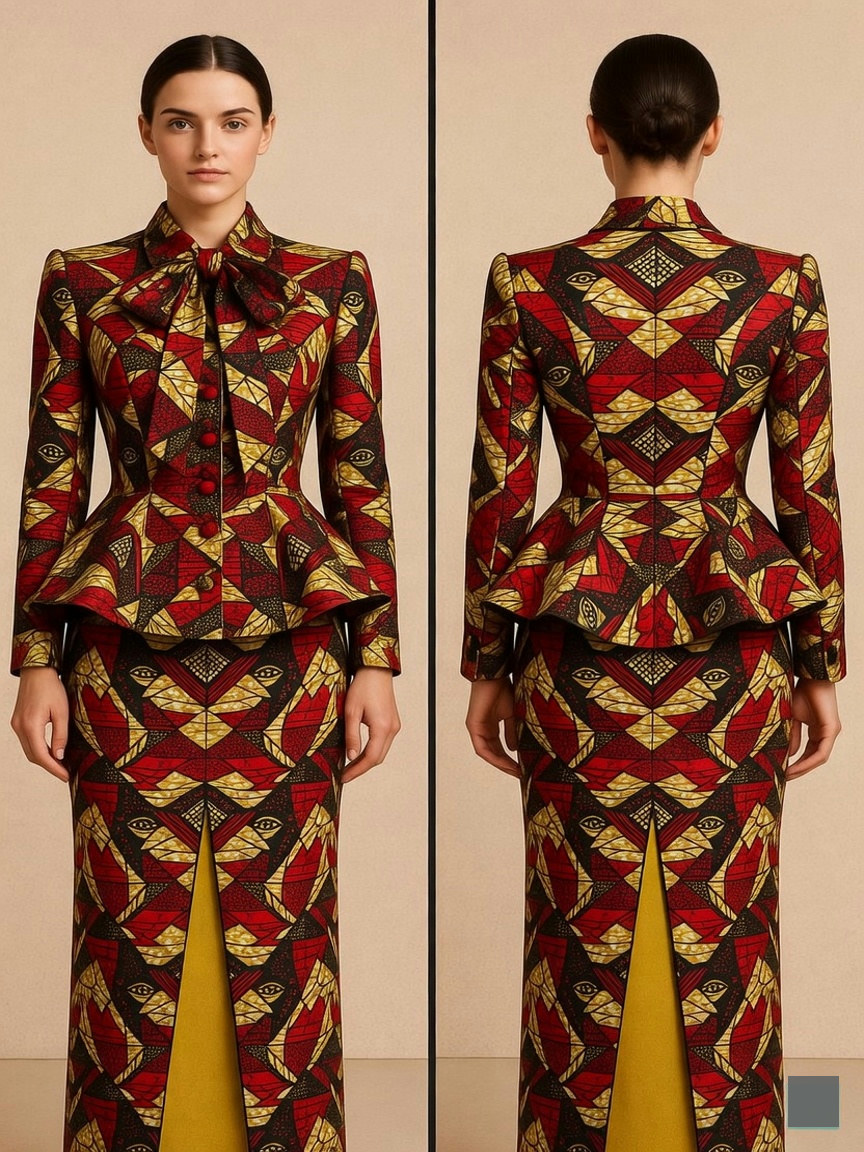
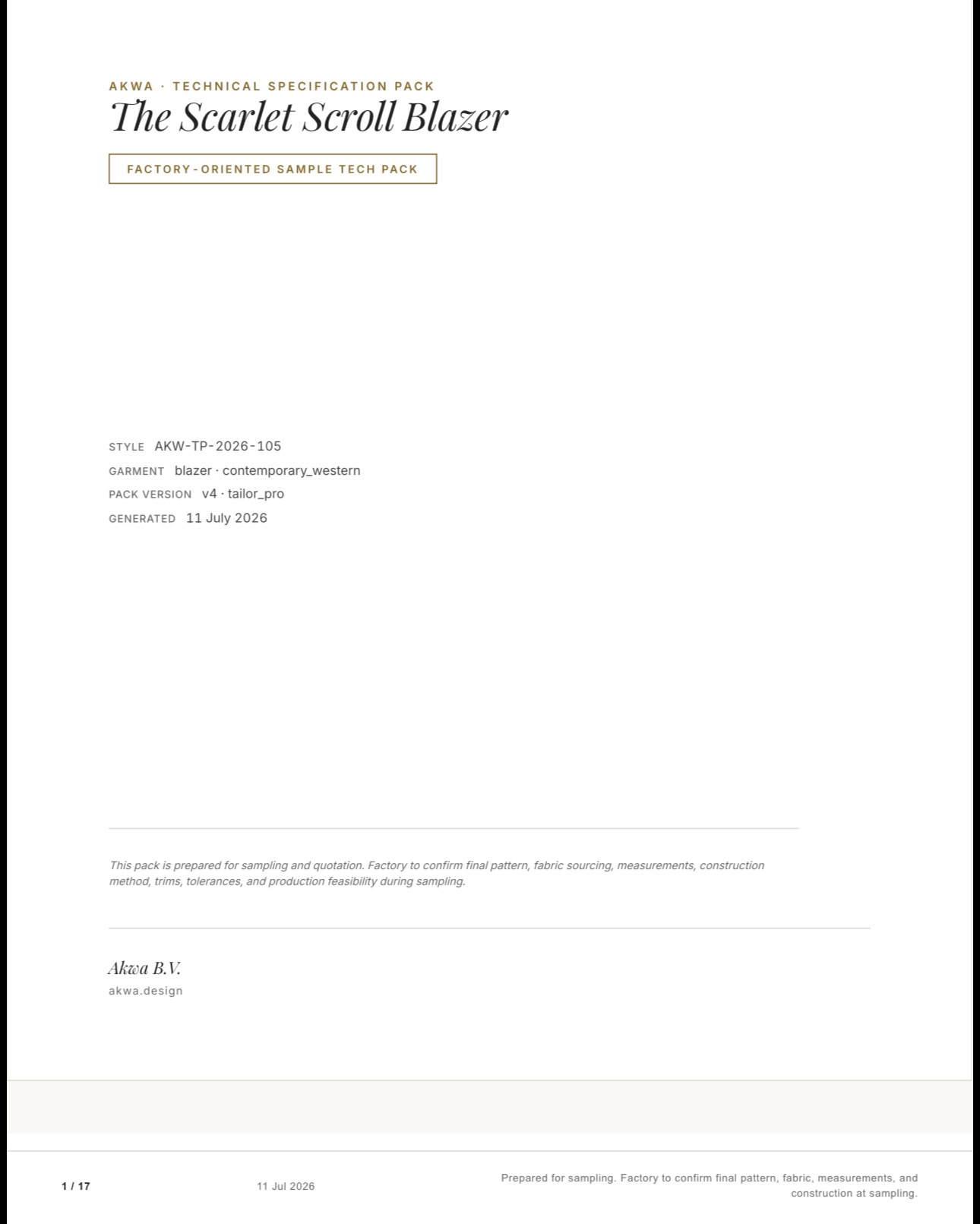
How it works: from a first description to a factory
One design object moves through every stage. Nothing is rebuilt from scratch, and nothing reaches a factory unchecked.
- Describe. A sentence, a sketch, a reference, or a photo. However the design starts.
- Design. Akwa captures the full design intent: silhouette, fabric behaviour, construction, and cultural register.
- Tailor Brief. Every design comes with a tailor-ready brief covering fabric, silhouette, construction, and styling.
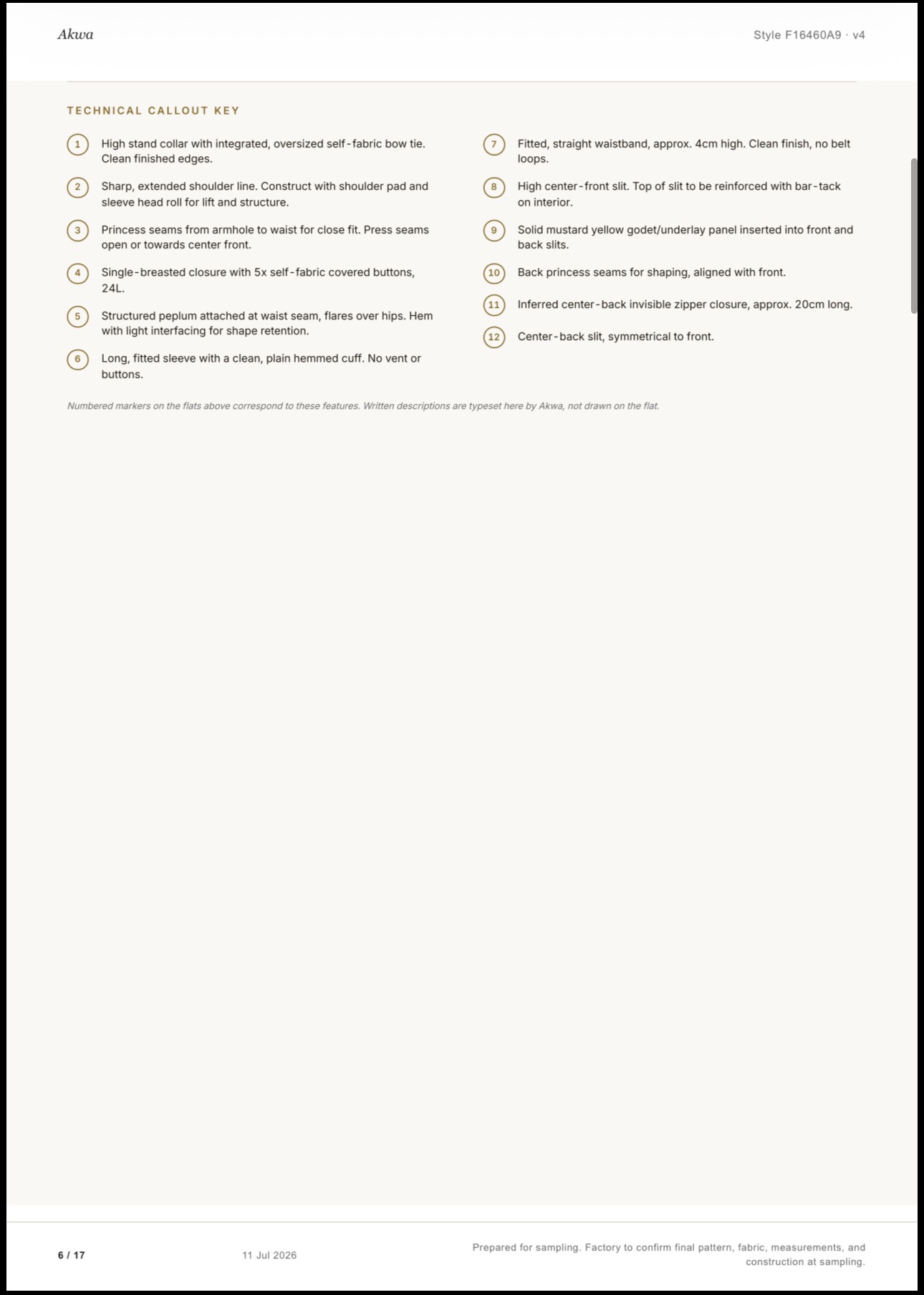
- Tech Pack. Multi-view flats with numbered callouts, Bill of Materials, graded measurements, construction sequence, and QC.
- Reconciliation. The pack is checked against your design; production-critical contradictions are surfaced to resolve.
- Independent Review. A separate automated reviewer reads the pack before handoff; remaining uncertainty is labelled to confirm at sourcing or sampling.
- Factory. A specification a tailor can quote and cut a first sample from.
Most tools stop at the Tech Pack. Akwa reconciles every pack against your design and runs it past a separate reviewer before a factory ever sees it.
The pack does not start from zero
A design on Akwa can begin as a sentence, a sketch, a reference, a set of structured choices, or an Akwa concept. From there it moves as one object: visual design, structured brief, tailor brief, tech pack, factory handoff. Because the pack is generated from the context Akwa already holds, it carries the design forward into production rather than rebuilding it from scratch.
Rigor, not just speed
Every pack is reconciled against your design and reviewed by a separate automated reviewer before handoff. A production-critical contradiction (one that would change what gets made) must be resolved first; any remaining uncertainty is labelled clearly for the factory or atelier to confirm at sourcing or sampling. The speed that matters is not how fast a document appears; it is how little has to be corrected after it does.
Every spec knows where it came from
A confident-looking measurement is not the same as a confirmed one. Akwa labels what it observed in your design separately from what it engineered, so a factory knows exactly what is fixed and what to confirm. An assumption is never disguised as a fact.
For brands and retailers: screened for resemblance before you cut fabric
A beautiful image is not evidence that a design is safe to manufacture. Every couture design on Akwa is screened by an originality reviewer that flags close resemblance to a recognizable design signature, and surfaces where a portfolio is converging, before a design moves toward production. Akwa is careful about what this is: similarity is a signal to review, not a verdict, and a novelty score is not a legal opinion. It is the review a serious brand would want done, done by default, with the evidence a human needs to decide.
Read the thinking behind it: AI fashion has an IP problem, and how Akwa engineered for design fidelity and trust.
Eight production layers
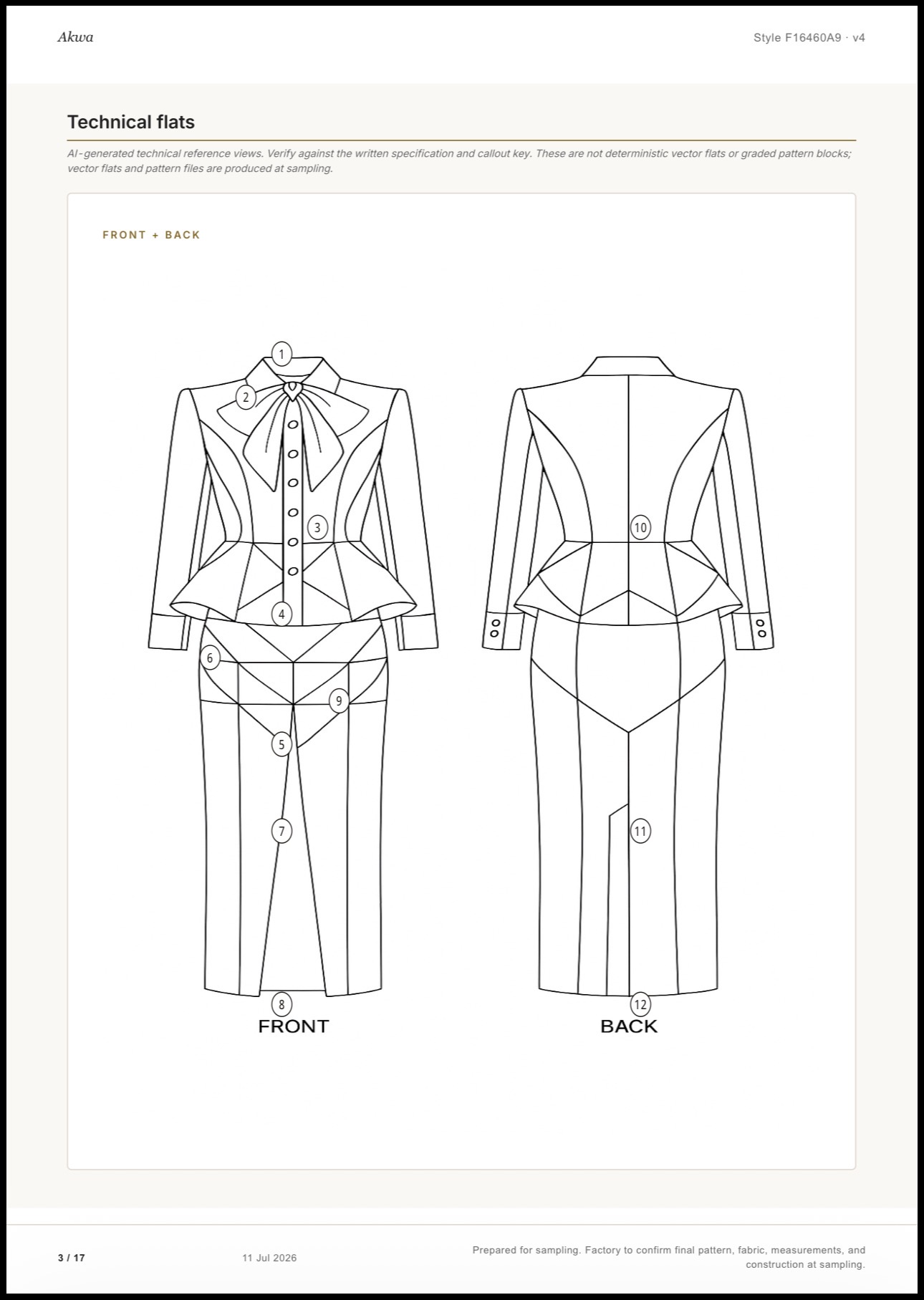
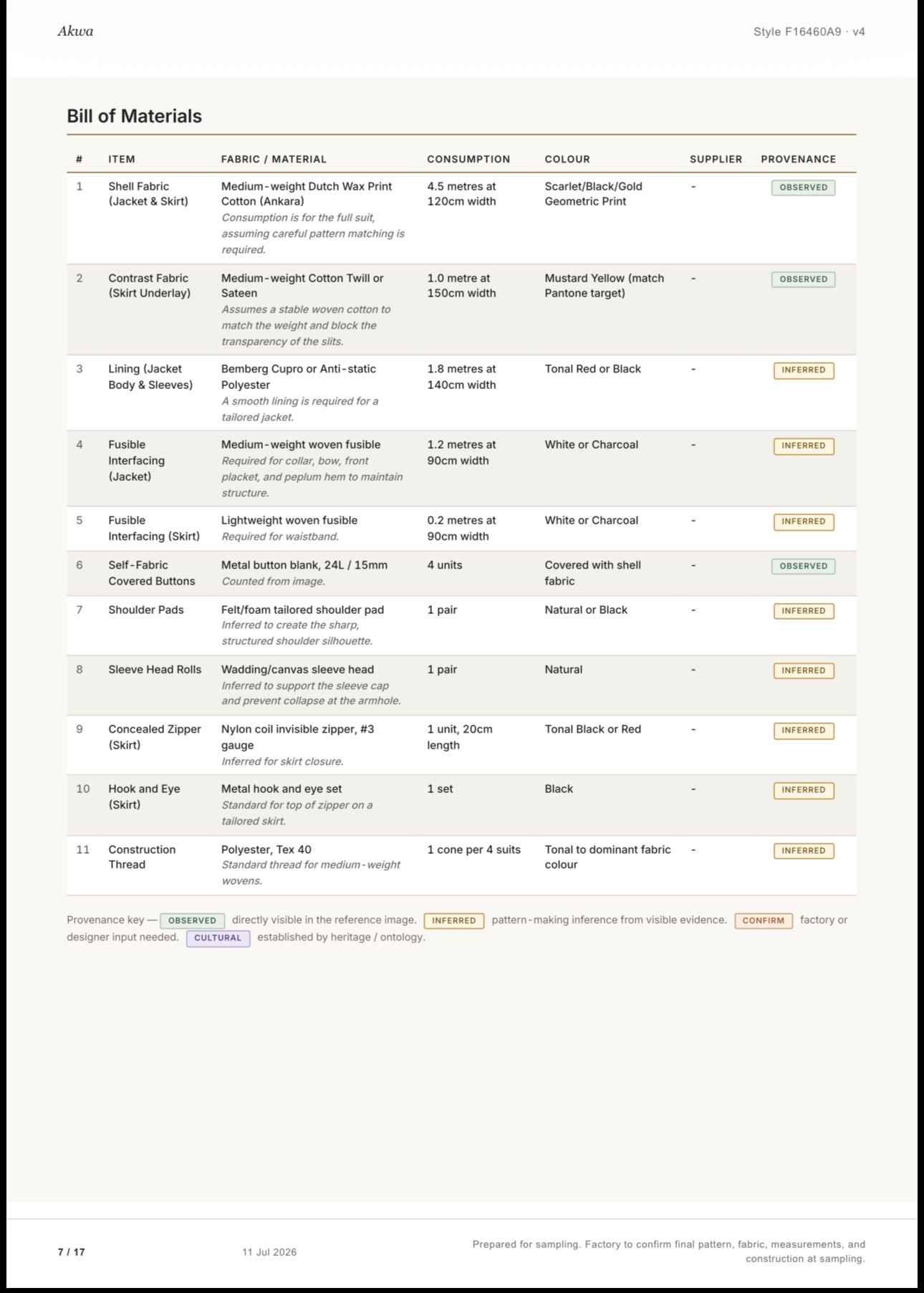
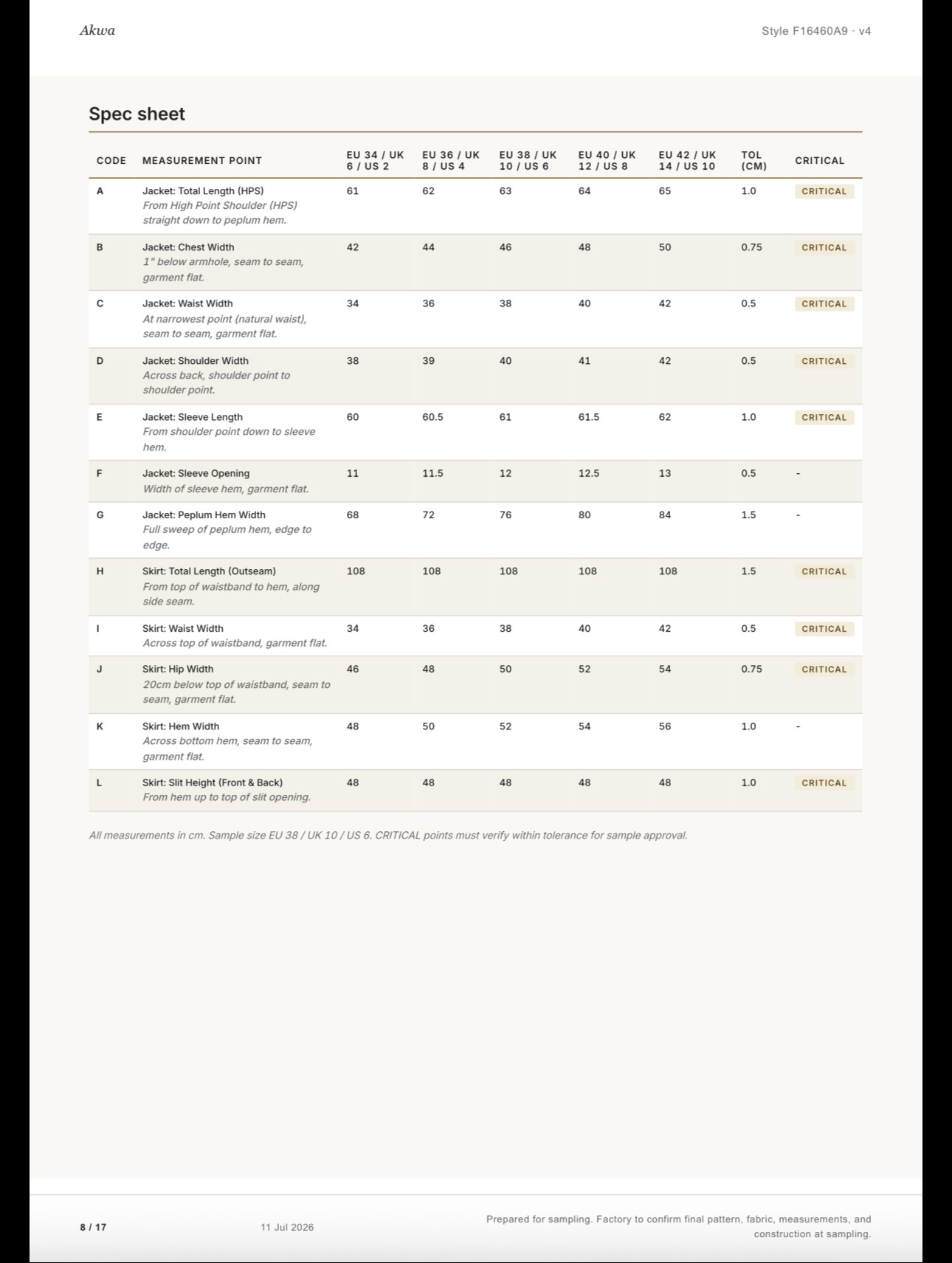
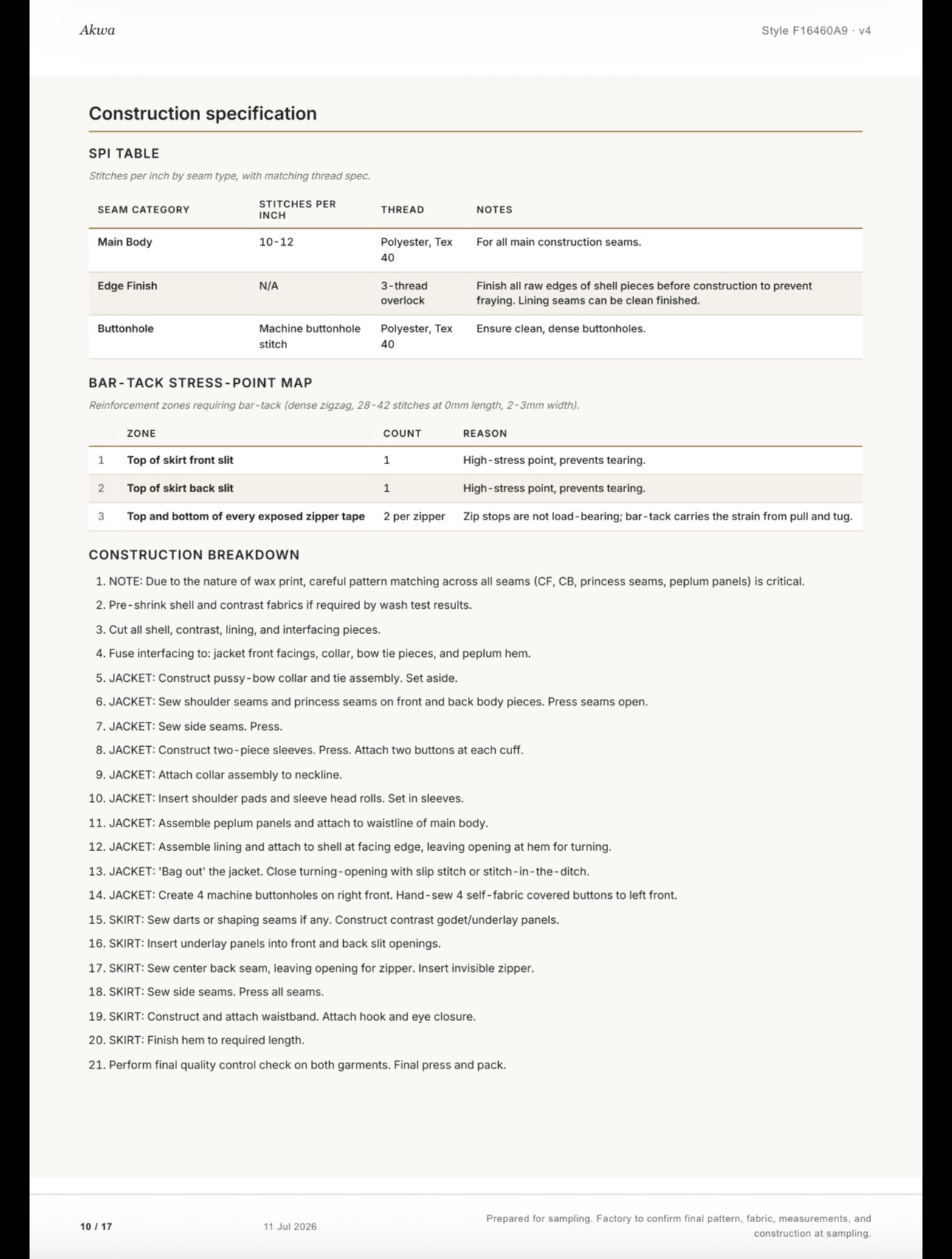
A sample Akwa Tech Pack: a wide-leg denim co-ord, with multi-view flats and twelve numbered callouts across front and back. Every Akwa Tech Pack ships with the production specification a tailor or factory expects, in the format they expect it:
- Cover and design brief. Garment family, occasion, cultural register, style brief in editorial register.
- Technical flats. Front and back technical flats with numbered callouts: reference drawings your factory confirms at sampling.
- Bill of Materials. Structured BOM: fabric, lining, interfacing, trim hardware, thread, consumption, and reference Pantone where applicable.
- Spec sheet and graded measurements. Critical measurement points, tolerance bands, and a seam allowance map per garment family.
- Construction sequence. Step-by-step assembly order, fabric handling, finishing details, and reinforcement zones with bar-tack maps.
- QC checklist and sign-off. Staged quality control at first fitting and final assembly.
- Reconciliation and review. The pack is checked against the design and reviewed by a separate automated reviewer; production-critical contradictions are resolved, and remaining uncertainty is labelled for the factory to confirm.
- Provenance labelling. What was observed and what was engineered are labelled separately, so a factory knows what to confirm.
Tech Pack vs Tailor Brief
The Tailor Brief is included in every Akwa design at no extra cost. It covers fabric, silhouette, construction, and styling, enough for an experienced tailor to make the garment.
The Tech Pack is the next level up: a factory-oriented sample tech pack with multi-view flats and numbered callouts, structured BOM, graded measurements, construction sequence, and staged QC. Used by manufacturers, ateliers, and serious tailors who want the specification a factory expects at first sample.
Who it is for
- Brands and retailers introducing AI into design and development, who need a pack that is reconciled, provenance-labelled, and screened before it reaches a supplier.
- Brand founders sending a design to a manufacturing partner for the first time.
- Boutiques commissioning capsule collections from external workshops.
- Streetwear and contemporary labels developing denim, jersey, and outerwear (hoodies, jackets) for a first production run.
- Tailoring houses and made-to-measure studios speccing suits, shirting, and formalwear.
- Occasion and eveningwear designers speccing dresses, gowns, and couture pieces.
- Diaspora customers commissioning Nigerian, Gulf, or South Asian couture from a tailor abroad.
- Asoebi coordinators running one fabric across twenty bodies in three cities, so every tailor receives identical construction grammar.
Tech Pack Plan: producing more than one style
Buy tech packs one at a time for EUR 25, or subscribe to the Tech Pack Plan and generate several a month at a lower price per pack. The plan covers tech packs only; design credits are separate.
- 3 packs a month, EUR 49 (EUR 16.33 per pack). For a small run of styles.
- 10 packs a month, EUR 139 (EUR 13.90 per pack). For an active collection.
- 15 packs a month, EUR 189 (EUR 12.60 per pack). For high-volume development.
Extra packs past the monthly quota are billed at the EUR 25 one-off. No rollover; the quota resets each billing period. Cancel anytime.
Frequently asked questions
Can I upload a photo of my design?
Yes. Uploading a photo of a design you already have is one of the two ways to get an Akwa Tech Pack; add an optional comment for anything the picture does not make obvious, and Akwa builds a factory-oriented pack from it. The other way is to design on Akwa, where the pack is drawn from the full intent already captured, and the design also comes with a Tailor Brief.
Does Akwa check a design against known fashion houses?
Couture designs are screened by an originality reviewer that flags close resemblance to a recognizable design signature and surfaces where a portfolio is converging. This is a signal for a person to review, not a legal clearance. Similarity is a signal, not a verdict.
How long does it take?
It is not instant, by design. A pack is composed, reconciled against the design, and reviewed by a separate automated reviewer before handoff; production-critical contradictions must be resolved first, and remaining uncertainty is labelled for the factory to confirm. Most packs are ready in 5 to 10 minutes.
How much does it cost?
EUR 25 flat, one global price worldwide via Stripe. No subscription required.
Is it bulk-production-ready?
No, and Akwa does not assign that status to any pack today. Every Akwa Tech Pack ships as a factory-oriented sample tech pack, prepared for sampling and quotation. The furthest stage a pack reaches is Sample stage resolved, which records that a named manufacturer sampled the garment and its open questions were closed. A bulk-production pack is a different document, and it would follow an approved sample, a confirmed pattern, final trims, final measurements and factory validation.
Refund policy?
14-day refund window from purchase, only if you have not downloaded or previewed the Tech Pack. Once delivered and viewed, the IP is yours; delivered packs are not refunded.